William Henry & Mary King Lifeboat
The Remarkable Journey of the William Henry & Mary King Lifeboat
A Lifeboat Born from Legacy
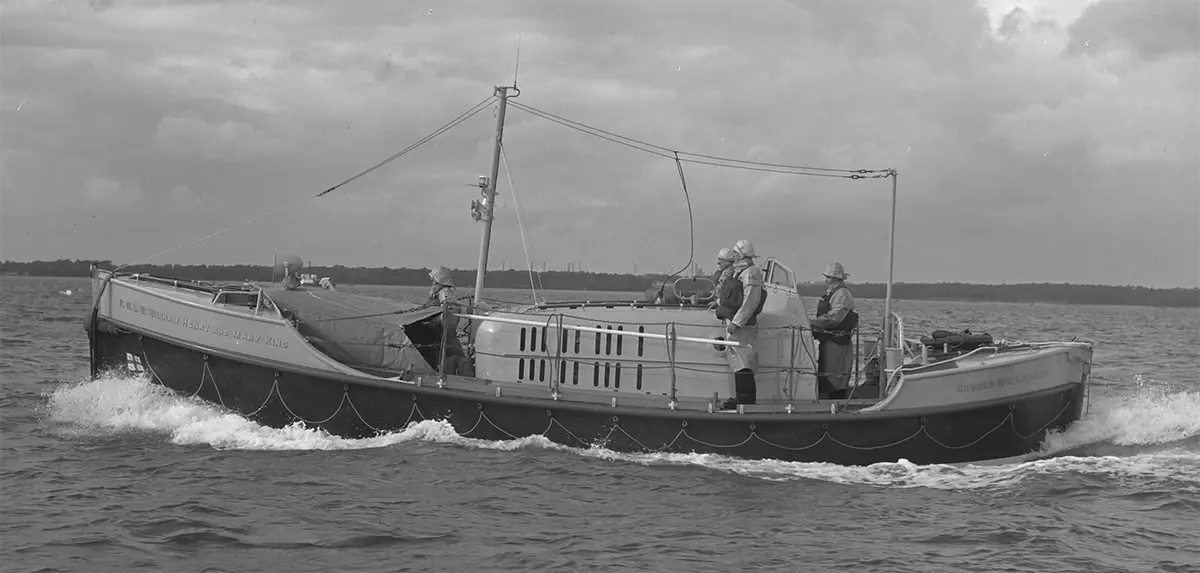
The William Henry & Mary King lifeboat, a 37ft Oakley class vessel, was built in 1964 by J S White on the Isle of Wight. This impressive craft was funded by a £33,000 legacy from Miss Jane Graham King of Sutton, Surrey, honoring her parents. Unlike most lifeboats, this vessel did not display her operational number due to a superstition associated with her being the thirteenth of her class.
A Grand Introduction
The arrival of the William Henry & Mary King was a momentous occasion for Cromer, a coastal resort in Norfolk renowned for its maritime history. Named by HRH Princess Marina, Duchess of Kent, in a ceremony on July 8th, 1965, the lifeboat’s dedication was attended by the Lord Lieutenant of Norfolk, the Bishop of Norwich, and a large crowd. Cromer’s proud fishing heritage and the lifeboat’s introduction marked a significant chapter in the town’s ongoing connection to the sea.
Service at Cromer: A Short but Significant Stint
Initially serving as Cromer’s No.2 lifeboat, the William Henry & Mary King was active until June 1967. During her brief tenure, she was launched twelve times, saving one life—a conservative estimate, according to service records. Despite her short service at Cromer, she played a crucial role in the town’s maritime safety, especially as the community transitioned to using faster, more maneuverable inshore lifeboats for closer rescues.
Bridlington: A Lifeboat’s True Home

In September 1967, the William Henry & Mary King found her true calling at Bridlington, a key seaside port on the North-East coast. Bridlington’s strategic location near Flamborough Head made it a hub for both fishing and rescue operations. The lifeboat station here is one of the oldest in the world, a testament to the frequent need for rescue operations in the treacherous North Sea.
During her time at Bridlington, the William Henry & Mary King was launched 291 times, more than any other 37ft Oakley lifeboat, and saved 83 lives. Her crew’s bravery was recognized through numerous awards, with her first Coxswain, John King, earning a Bronze Medal in 1968, followed by a bar to his Bronze Medal in 1972 and a Silver Medal in 1973. After John King’s retirement, Fred Walkington took over as Coxswain, earning his own Bronze Medal in 1979.
Beyond Lifesaving: A Vessel with Versatility
The William Henry & Mary King was not only a lifesaver but also played crucial roles beyond her primary duty. She assisted the Royal Navy in dealing with wartime mines and even helped rescue a sick crewman from a Russian trawler during the Cold War, overcoming language barriers with the help of local interpreters.
Upgrades and Modifications
Throughout her service, the William Henry & Mary King underwent several modifications to enhance her capabilities. In 1971, she was fitted with a small canvas shelter, which was later upgraded to a larger metal-framed canopy in 1982. Radar was installed in 1977, a significant advancement for the small Oakley class lifeboats. Major repairs to her hull in 1985 kept her seaworthy, and additional repairs in 1988 further extended her service life.
The End of an Era
In January 1989, the William Henry & Mary King was replaced by the faster, more advanced Mersey class lifeboat, Peggy & Alex Caird. Even in her later years, she continued to serve, including a temporary assignment at the Seahouses station, though by then, age had taken its toll on the vessel.
Finally, on July 23rd, 1991, the William Henry & Mary King was retired and declared non-operational after 27 years of service. With 312 launches and 84 lives saved, her legacy as a steadfast guardian of the seas is firmly etched in maritime history.
Conclusion
The William Henry & Mary King lifeboat exemplifies the courage, dedication, and innovation that define the RNLI’s lifeboat service. Her storied history at both Cromer and Bridlington, her crew’s heroism, and the vessel’s adaptability make her a legendary figure in the annals of maritime rescue.